
A Formula 1 pit crew doesn’t wait until every sensor, camera, and engineer agrees that a tire needs changing. They have a few seconds to make a decision using the best evidence available. Wait for perfect certainty, and the race is already lost.
Security operations work much the same way.
When an alert lands in the SOC, attackers don’t pause while analysts gather more context. They continue delivering payloads, harvesting credentials, moving laterally, and expanding their foothold.
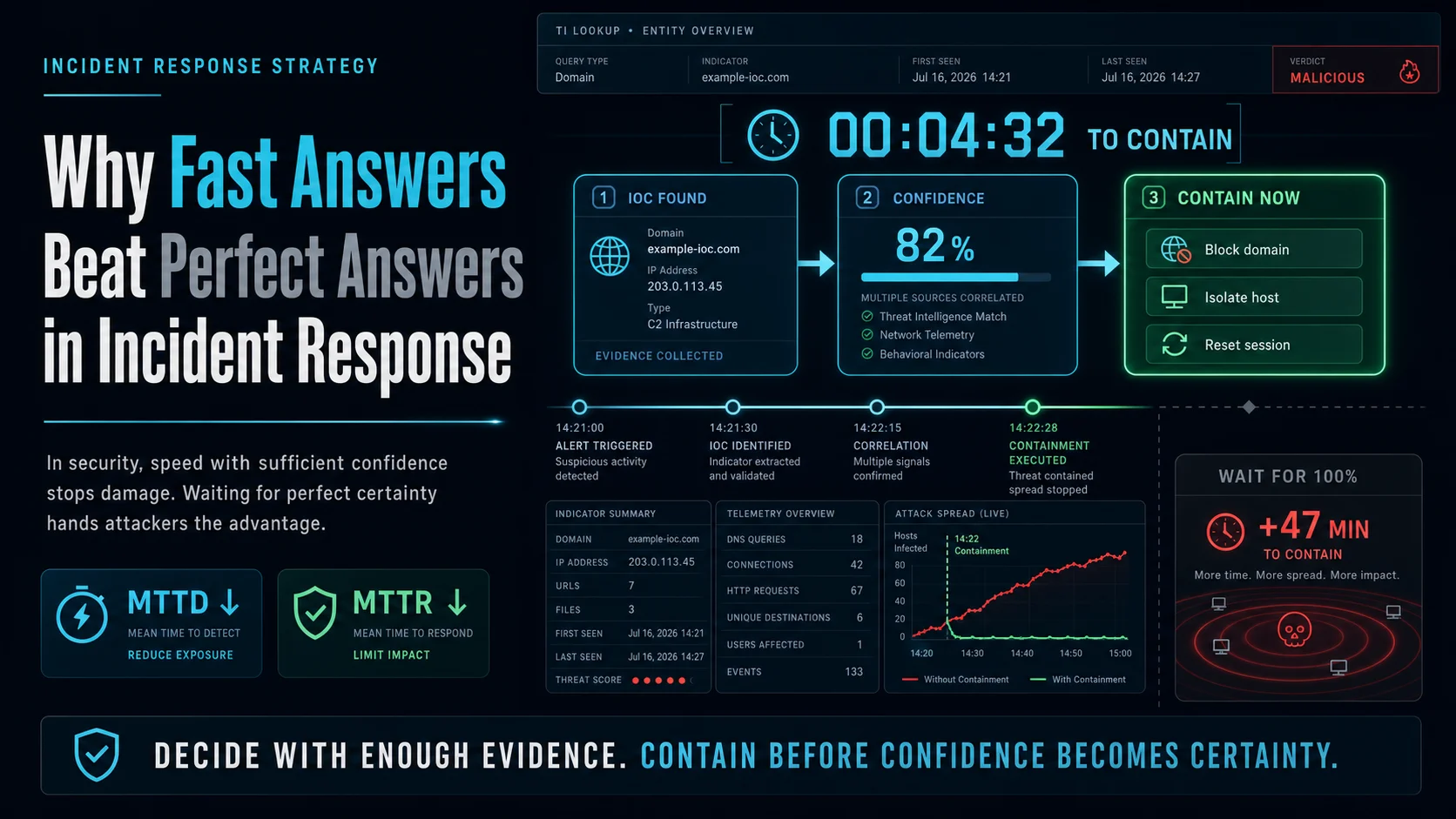
The goal of incident response isn’t to achieve perfect certainty before taking action. It’s to reach the right level of confidence fast enough to reduce business risk.
For Tier 1 analysts, that often means answering one deceptively simple question:
Is this just another false positive, or the first visible symptom of something much bigger?
The faster that question is answered with evidence rather than assumptions, the better the outcome for both the analyst and the business.
The Pursuit of Perfect Can Become a Security Risk
SOC analysts are trained to investigate carefully.
- Verify the IOC.
- Check the endpoint.
- Review network traffic.
- Look for related activity.
- Confirm malware.
- Correlate additional alerts.
Those habits are essential. But under pressure, they can also create an unintended trap: delaying action while searching for complete certainty.
Meanwhile, attackers are making progress.
Modern attacks rarely unfold in a single event. They develop as a sequence of opportunities. A phishing email becomes a stolen credential. A malicious download becomes persistence. One compromised endpoint becomes several. The earlier defenders interrupt that chain, the smaller the incident becomes.
In other words, every investigation has an expiration date.
Good Triage Is About Confidence, Not Certainty
The objective of Tier 1 triage is not to prove exactly what happened. It is to determine what should happen next.
- Should the alert be closed?
- Should the endpoint be monitored?
- Should a domain be blocked?
- Should the incident be escalated?
These decisions do not require perfect information. They require sufficient evidence.
The strongest SOCs recognize that confidence is something analysts build progressively. Each new piece of evidence either strengthens or weakens the breach hypothesis until a reasonable decision becomes clear.
Why Analysts Lose Time
Most investigations are not slowed by complex malware. They are slowed by fragmented information.
An analyst may need to consult:
- A reputation service
- WHOIS records
- Passive DNS
- Malware repositories
- Internal telemetry
- Previous incident tickets
- Threat reports
- Sandbox results
None of these sources is inherently slow. Switching between all of them is. By the time enough context has been collected, the queue has grown, new alerts have appeared, and the investigation has already become more expensive than it needed to be.
Context Reduces Uncertainty Faster Than Reputation
Many investigations still begin and end with a reputation score. That is rarely enough. A suspicious IP address tells very little by itself.
Questions that matter far more include:
- Which malware families communicate with it?
- Has it appeared in recent phishing campaigns?
- What related domains and URLs are connected to it?
- How recently was it observed?
- What behavior did associated malware exhibit?
- Are there related indicators that should also be investigated?
Context transforms an isolated IOC into an evidence-based decision.
Instead of asking, “Is this IP malicious?”
Analysts begin asking,
“What attack is this IP part of?”
That shift dramatically improves investigation quality while reducing investigation time.
From IOC to Evidence with ANY.RUN Threat Intelligence Lookup
They can immediately explore:
- Related malware and phishing samples
- Connected infrastructure
- Associated file hashes and URLs
- Threat family classifications
- Behavioral tags
- First- and last-seen timestamps
- Detection names
- Relationships between indicators
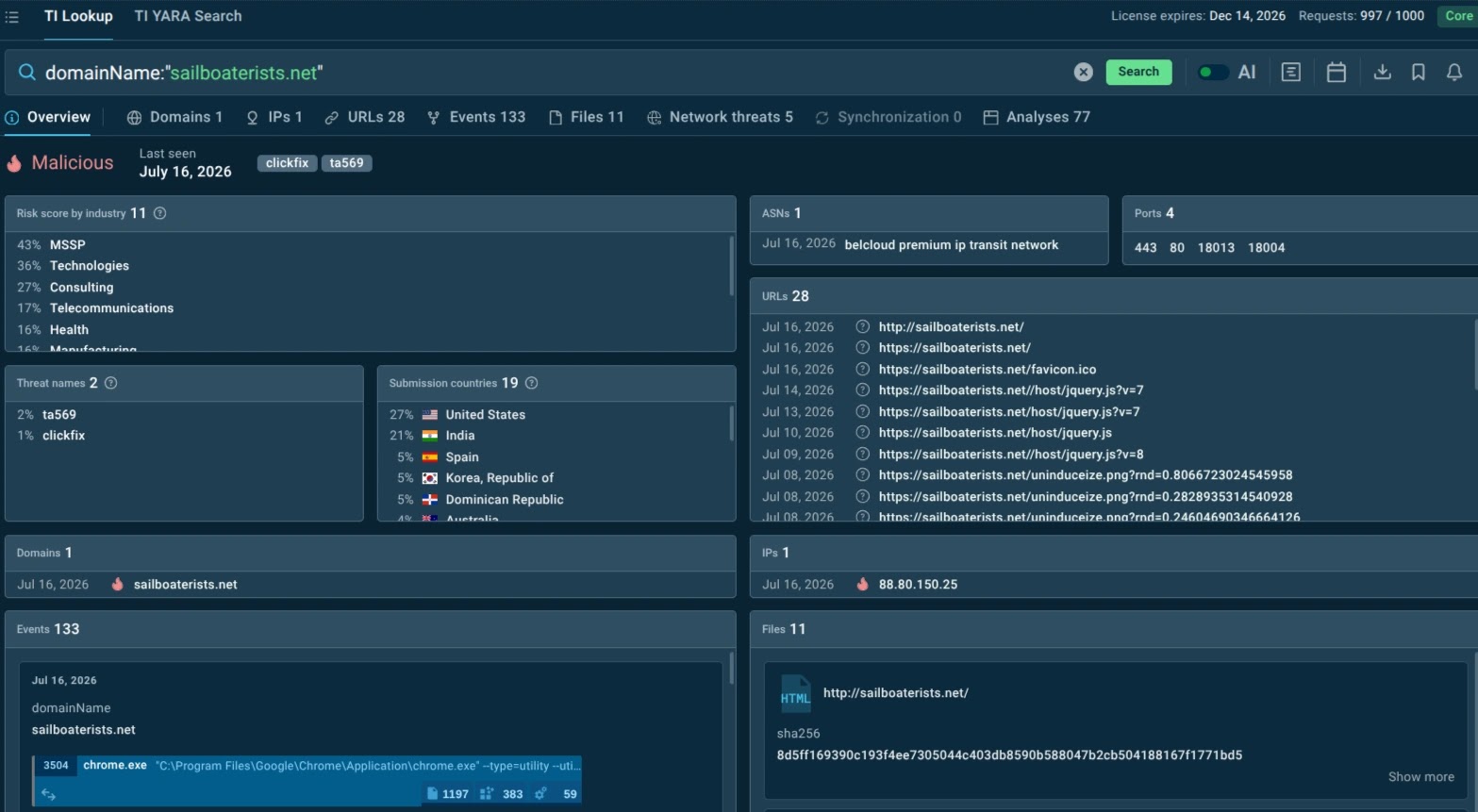
That additional context helps Tier 1 analysts make faster, more defensible decisions without sacrificing investigation quality.
See the Attack Behind the Indicator
Knowing that an IOC is associated with malware is useful, but seeing what that malware actually does is even more valuable.
Instead of relying solely on static reputation or historical records, analysts can observe:
- Process execution
- Network communications
- File system activity
- Registry modifications
- Persistence attempts
- Credential theft behavior
- Additional payload downloads
- Command-and-control communication
This behavioral perspective makes it easier to understand whether activity observed inside the organization matches the techniques used by known malware.
It also strengthens investigation findings with evidence that goes beyond a simple malicious verdict.
Scale Good Decisions Across the SOC
Individual investigations are only one part of the picture.
Once intelligence has been validated, organizations need to operationalize it across their security environment.
Security teams can integrate these feeds with SIEM, SOAR, EDR, XDR, TIP, firewall, and other security platforms to automate enrichment, improve detections, support proactive threat hunting, and accelerate response.
This creates a continuous intelligence cycle:
- The Interactive Sandbox observes real attacker behavior.
- Threat Intelligence Lookup helps analysts investigate suspicious artifacts with rich context.
- Threat Intelligence Feeds distribute fresh intelligence throughout the security stack.
- Every investigation strengthens future detections and response.
Instead of repeatedly solving the same investigation from scratch, the SOC continuously builds on what it has already learned.
The Business Value of Faster Answers
For analysts, faster investigations mean less context switching, fewer manual searches, and greater confidence during triage.
For SOC managers, they mean fewer unnecessary escalations and better use of senior analysts’ time.
For CISOs, they translate into shorter dwell times, faster containment, and lower operational costs.
None of these outcomes depends on making perfect decisions every time.
They depend on making well-informed decisions before attackers gain the initiative.
Conclusion
Speed and accuracy are often presented as competing goals. In reality, they reinforce one another when analysts have access to the right intelligence.
The objective is not to rush investigations or lower the standard of evidence. It is to reduce the time needed to reach a confident decision.