A sophisticated Android malware campaign is exploiting heightened geopolitical tensions in the Gulf region by masquerading as an official Bahrain Civil Defense emergency alert application.
Security researchers have uncovered a fake “BH Alert” app that delivers a multi-stage Remote Access Trojan (RAT) capable of harvesting sensitive user data, including lockscreen PINs, one-time passwords (OTPs), SMS messages, and banking credentials.
Throughout July, Gulf nations such as Bahrain and Kuwait activated civil defense sirens and emergency guidance following regional missile threats. This surge in public safety awareness has driven increased downloads of official alert apps, creating an opportunistic window for threat actors.
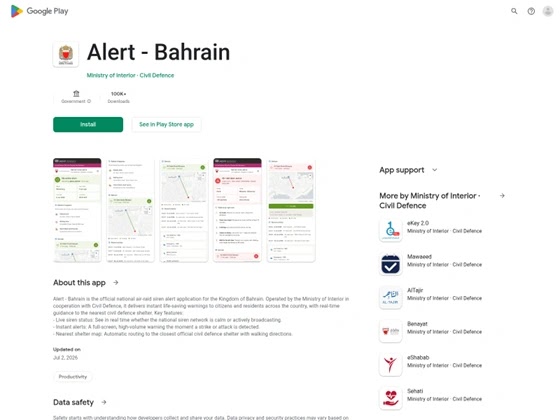
Researchers from DreamGroup identified the malicious campaign on July 17, noting that attackers leveraged this urgency to distribute trojanized apps via fake Google Play pages and spoofed Bahraini government portals.
The malicious infrastructure mimics legitimate platforms with high accuracy, featuring fake download counts, fabricated user reviews, and fraudulent “Verified by Play Protect” badges.
Fake Bahrain Civil Defense App Deploys Android RAT
The campaign relies on a network of lookalike domains to lure targets:
playgoogle[.]alertbh[.]comdownload[.]alert-bh[.]comdownload[.]bh-security[.]com

These landing pages replicate Google Play storefronts and official government portals, complete with simulated installation animations and Meta Pixel tracking scripts. Victims are tricked into downloading a malicious APK hosted outside official app stores.
Two primary delivery vectors were observed:
- Google Play Impersonation: Pages featuring fake install sequences and delayed APK delivery.
- Government Portal Spoofing: Civil defense branding and Meta Pixel tracking for user interaction.
The initial infection vector is likely smishing or malicious links distributed via social media and messaging platforms.
The fake BH Alert app deploys a complex four-stage infection chain engineered for stealth and persistence:
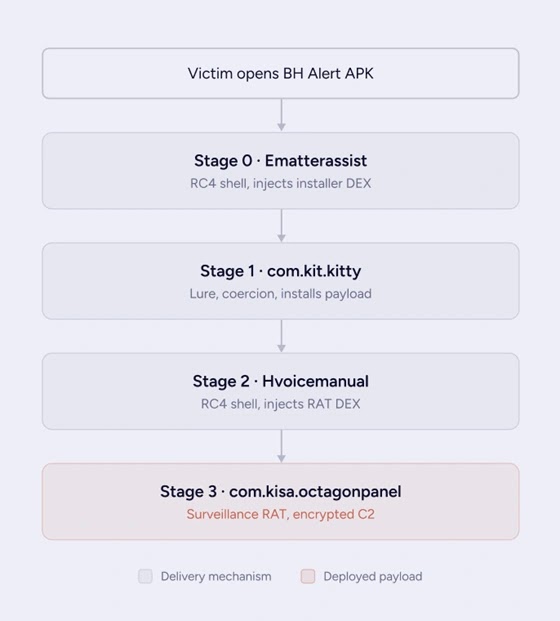
- Stage 0 (
Ematterassist): RC4-encrypted loader disguised as a font file (ZfChs.ttf) injects hidden DEX code. - Stage 1 (
com.kit.kitty): Social engineering interface requests permissions and installs a secondary APK payload. - Stage 2 (
Hvoicemanual): Secondary RC4 shell decrypts and executes the main RAT payload. - Stage 3 (
com.kisa.octagonpanel): OctagonPanel / Ward RAT establishes full device surveillance and C2 control.
For example, the initial APK decrypts ZfChs.ttf, which contains executable Android bytecode, allowing the malware to bypass basic static detection rules.
Once installed, the RAT abuses Android Accessibility Services (WardAccessibilityService) and elevated system permissions to gain granular control over the device.
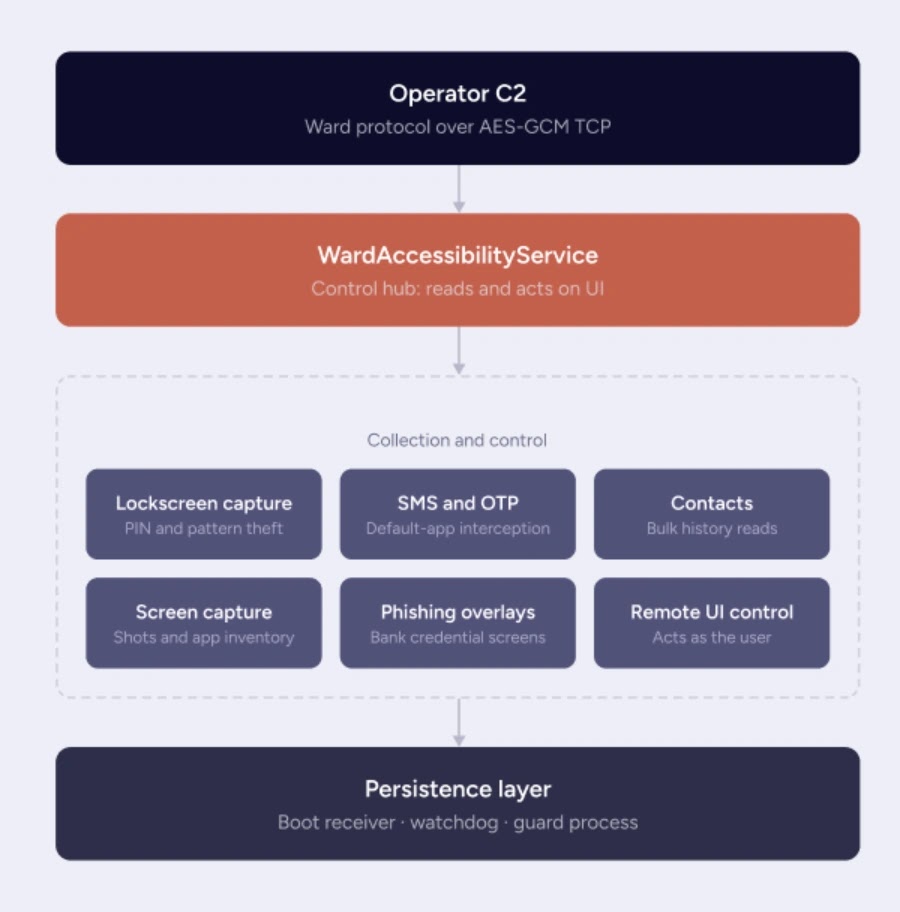
Key capabilities include:
- Lockscreen Theft: Harvesting PINs and pattern unlock inputs.
- Message Interception: Capturing SMS traffic and OTP verification codes.
- Phishing Overlays: Displaying fake login forms over banking apps, mirroring tactics seen in banking trojan campaigns.
- Visual Reconnaissance: Capturing screenshots and monitoring UI activity.
- Data Exfiltration: Bulk reading contacts, call logs, and installed app inventories.
- Remote Commands: Executing administrative tasks via encrypted C2 communication.
The malware establishes persistence using foreground services, watchdog processes, and boot receivers to survive reboots and removal attempts. Similar android malware threats continue to target mobile users across volatile regions.
A notable technical mechanism involves deploying a fake VPN service that intentionally disrupts normal device connectivity. While legitimate applications lose internet access, attacker-controlled components remain functional. This forces victims to complete the malicious setup process while preserving the attacker’s communication channel, reads the DreamGroup report.
The malware incorporates several anti-analysis controls:
- RC4-encrypted payloads hidden inside
.ttffont files and.jararchives. - Runtime code injection directly into the Android classloader.
- Obfuscated code paths and junk logic to hinder reverse engineering.
- Decoy usage of legitimate system libraries.
- Exclusion of accessibility overlays from the recent apps menu.
Takeaway for Defenders
Users in affected regions are strongly advised to take the following defensive steps:
- Download apps exclusively from official app stores.
- Verify developer credentials prior to installation.
- Avoid clicking links delivered via unsolicited messaging.
- Review app permissions carefully, paying special attention to Accessibility Services and SMS access.