Enterprise generative AI policies often begin with familiar tools: chatbots, image generators and coding assistants.
They may explain what employees can paste into a prompt, which services require approval and how generated content should be reviewed.
That coverage is becoming incomplete. Game studios, product teams, architects and marketing departments are beginning to use AI systems that turn prompts or reference images into 3D models.
These tools can accelerate early experimentation, but they also introduce inputs and outputs that may not fit policies written primarily for text.
Security teams do not need to prohibit generative 3D tools. They do need to understand where these tools enter the creative pipeline and apply controls that reflect the actual data, files and people involved.
The Policy Gap Begins With the Input
A 3D generation request may appear harmless when it contains only a short description of a generic object.
The risk profile changes when an employee uploads an unreleased product sketch, a confidential character design or a reference image supplied under a client agreement.
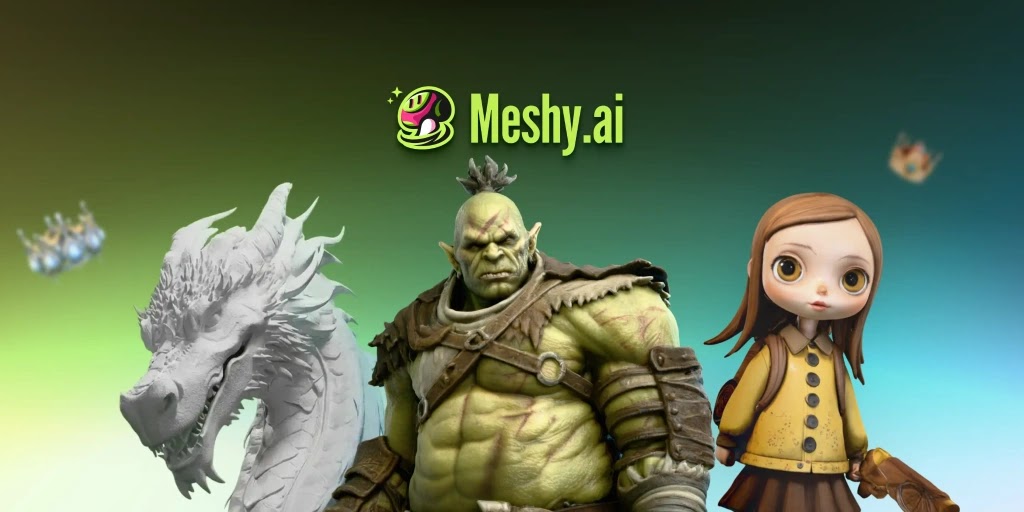
Platforms such as Meshy AI illustrate how accessible text- and image-driven 3D creation has become.
That accessibility is useful for creative teams, but it means employees may adopt a tool before security, legal or procurement teams know it is part of the workflow.
A policy should therefore distinguish between several input categories:
| Input type | Example | Suggested treatment |
| Public information | A generic medieval chair | Generally lower risk |
| Internal material | An early environment concept | Use only with an approved service |
| Confidential material | An unreleased product design | Require explicit authorization |
| Regulated or personal data | A scan connected to an identifiable person | Restrict according to legal and privacy rules |
The important question is not simply whether a tool uses AI. It is whether the information supplied to it is authorized for that environment.
Creative Files Need Their Own Data Classification Rules
Many corporate policies classify contracts, source code and customer records but say little about creative assets.
Yet a rough model or reference image may reveal future products, campaign plans, licensed characters or client work.
Security and creative leaders should classify these materials before choosing tools. A practical policy can answer:
- Which references may be uploaded to external services?
- Does client-owned artwork require separate approval?
- Are unreleased designs treated as confidential information?
- Where may generated files be stored?
- Who can share an asset outside the project team?
This avoids forcing artists to interpret broad statements such as “do not upload sensitive data” without examples relevant to their work.
Tool Approval Should Cover the Whole Lifecycle
Vendor review is only one part of responsible adoption. Security teams also need to understand how employees sign in, where files move after generation and what happens when a project ends.
The review should consider account ownership, permission management, retention requirements and the process for removing access when an employee or contractor leaves.
Teams should also document whether they use individual accounts, centrally managed accounts or shared credentials.
Shared credentials reduce accountability and should not become the default simply because a creative tool began as an experiment.
Approval also needs an expiration point. A service accepted for a short prototype should not automatically remain approved for confidential production work.
Generated Does Not Mean Trusted
An AI-generated model should be treated as an external input until it has passed the same checks applied to other third-party assets.
Generation does not guarantee that a file is technically suitable, safe to import or appropriate for publication.
A review process may include:
- Confirming the expected file type and extension
- Importing the asset in a controlled test project
- Inspecting geometry, materials and external references
- Checking for unexpected scripts or linked resources
- Reviewing licensing and provenance records
- Verifying that the model does not expose confidential references
- Recording any substantial human modifications
The exact checks will depend on the application and file format. The goal is to prevent convenience from bypassing controls already used for downloaded models, contractor deliveries and marketplace assets.
Can file conversion replace security validation?
No. Conversion may make a file compatible with another application, but it should not be treated as malware scanning, content review or proof of safety. Compatibility and security are different questions.
Provenance Matters After the Model Leaves the Tool
The moment a generated model enters a shared asset library, its origin can become difficult to reconstruct.
A colleague may see only the latest exported file and have no record of the prompt, reference material, generation date or subsequent edits.
A lightweight provenance record should travel with the asset. It can include:
- The tool and account used
- The date of generation
- The project owner
- A description of the input
- Links to approved internal references
- Exported formats
- Review status
- Major manual changes
This record does not need to expose confidential prompts to everyone. Access can follow the project’s existing permissions.
What matters is preserving enough information for an audit, dispute or incident investigation.
Different Generation Methods Create Different Questions
Not every 3D workflow handles the same type of input. An AI 3D generator that starts from a written description may present a different information-sharing decision from a process that begins with a proprietary reference image.
Security policies should reflect that difference. If a team can achieve an early result with a generic text prompt, it may not need to upload confidential visual material.
Conversely, when reference images are essential, the team should confirm that their classification permits use in the approved environment.
This is a more useful control than banning an entire category of tools. It encourages employees to choose the least sensitive input that can accomplish the task.
Security and Creative Teams Need Shared Ownership
Security teams can establish requirements, approve services and investigate incidents, but they may not recognize when a rough sketch contains valuable intellectual property.
Creative teams understand the assets but may not be able to evaluate account controls or data-handling terms alone.
Responsibility should therefore be divided clearly:
| Responsibility | Primary owner |
| Classifying designs and references | Creative or project owner |
| Approving tools and access methods | Security and IT |
| Reviewing contractual restrictions | Legal or procurement |
| Inspecting generated assets | Technical artist or developer |
| Recording provenance | Asset owner |
| Reporting unexpected behavior | Every user |
This model keeps security involved without making it the only team responsible for decisions that depend on creative context.
A Useful Policy Should Guide Real Decisions
A generative 3D policy does not need to become a lengthy document. It should tell employees which tools are approved, what information they may submit, where outputs should be stored and what review is required before an asset enters production.
It should also provide a clear route for exceptions. Creative teams will encounter new formats, clients and tools faster than a policy can be rewritten.
A defined approval path is safer than leaving employees to work around rules that no longer reflect their needs.
Generative 3D AI is becoming another component of the enterprise software environment.
Addressing it early allows organizations to support experimentation while retaining control over confidential inputs, third-party files and the history of assets that eventually reach customers.